
Longreading Lists
a roundup of all the reading lists I’ve written for Longreads so far

Hello, friends and listlovers!
Here’s a roundup of all the reading lists I’ve written for Longreads—eight in all over the last two years. As it turns out, “explore obsessions and fall into rabbit holes” is an invitation I cannot resist 😇
This lovely connection means I get to work with the reading list not just as a list, or a curation, or a longform piece of writing, or an academic exercise, but as a wide-ranging, deeply interwoven literary form in itself. For the curious reader, each list—featuring an original essay-style introduction followed by a careful composition of longreads—is an exciting invitation to a whole new world.
I discovered that each list, upon publication, took on a life of its own. Some brought appreciative mails from friends, fellow writers, and strangers. Some were happily reposted by the featured authors and publications and discussed on forums. Some found their sentences on Merriam-Webster under Recent Examples on the Web (programmatically selected and continually rolled over for fresh examples, but hey, nothing like seeing your sentences in the dictionary to make you pay close attention to what you write). But best of all, the lists were (and continue to be) so much treasure-box fun!
My thanks to my wonderful editor Krista Stevens, who is as astute with her feedback as she is generous with her praise. And thanks to excellent copyeditor Cheri Lucas Rowlands, who makes each piece as secure as it can be, and to Brendan Fitzgerald for close-reading the latest one. And my thanks to Peter Rubin and Carolyn Wells for their lovely newsletter intros. It’s a good feeling when a totally professional publication is also warmly human. My work is the better for theirs.
Check out list excerpts below. Click the titles to read them in full. Enjoy!
Note: This is a long post, so please click the title up top to see the whole thing. The earlier roundup has been subsumed into this one.
Seeing is Believing: A Visual-Thinking Reading List on Making Meaning from Data
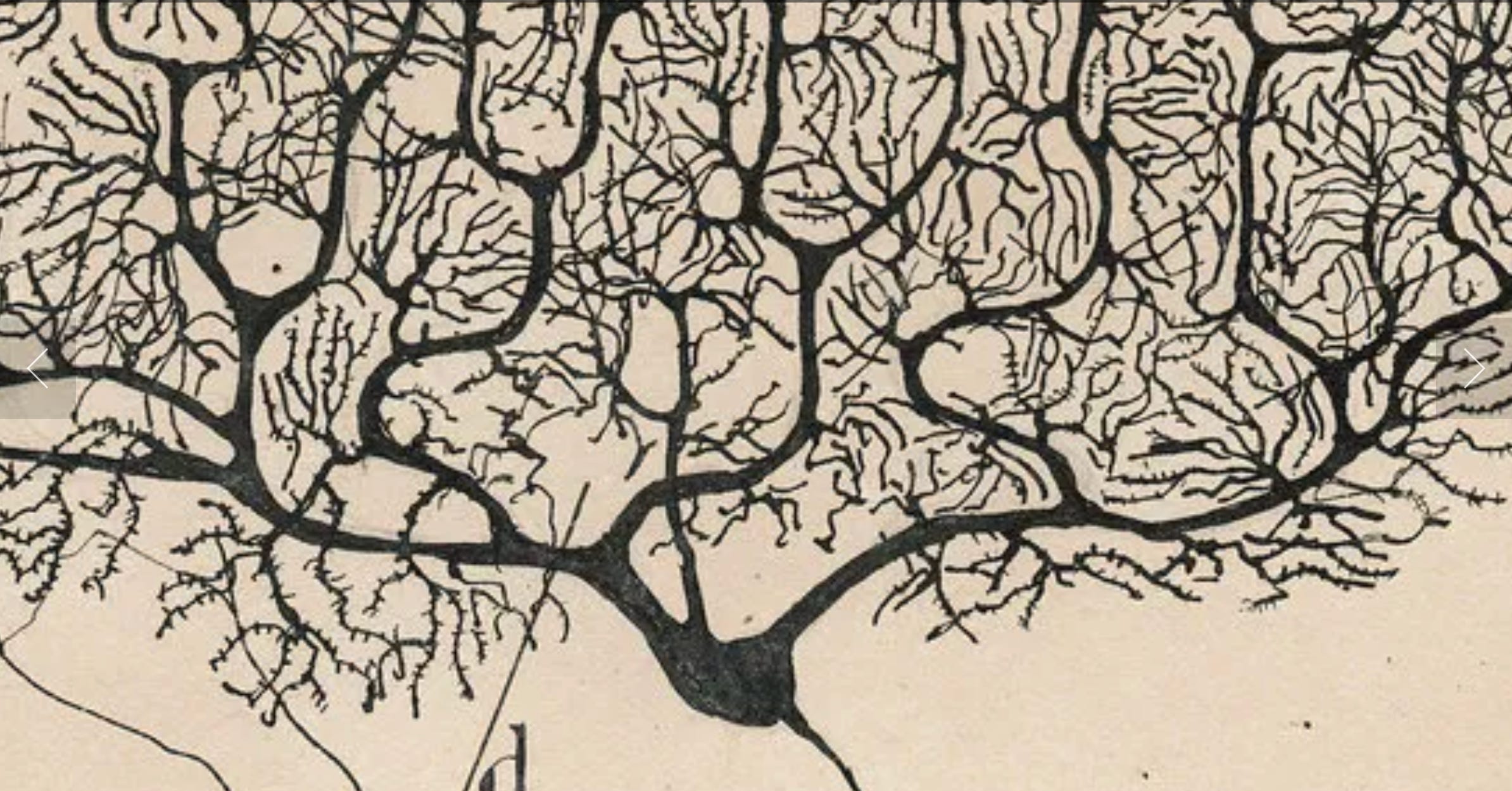
A purkinje neuron from the human cerebellum, Santiago Ramón y Cajal. Wikimedia Commons. Public domain.

Excerpt 1
Some 36,000 years ago, an Aurignacian—an anatomically modern Paleolithic human about 5′ 9″ tall—stood facing the cold walls of a vast cave by the Ardèche river. Patiently he scraped the surface using sticks and bones, removing a fine layer of brown clay and exposing the white limestone beneath. As darkness fell, he lit his pine torch. He traced the natural ridges and recesses of the rock with his fingers. Taking a piece of charcoal, he made his first mark.
We step, through film and image, into the prehistoric darkness of the Grotte Chauvet-Pont d’Arc, or the Chauvet Cave, in southern France, and stand before the same walls. Passing horses, reindeer, aurochs, cave bears, woolly rhinos, and mammoths finely rendered in charcoal and red ocher, we come upon the deepest End Chamber. From the right end of a magnificent 36-foot panel emerges a pride of 16 cave lions, male and female, intently stalking a fleeing herd of bison to the left.
Excerpt 2
Here I recall an anecdote about visual thinking from “Surely You’re Joking, Mr Feynman!”—one I never forgot and have put to good and frequent use. The physicist says: “The mathematicians would come in with a terrific theorem, and they’re all excited. As they’re telling me the conditions of the theorem, I construct something which fits all the conditions. You know, you have a set (one ball)—disjoint (two balls). Then the balls turn colors, grow hairs, or whatever, in my head as they put more conditions on. Finally they state the theorem, which is some dumb thing about the ball which isn’t true for my hairy green ball thing, so I say, ‘False!’” 🦠
Map Room: A Radical Reading List on Cartographic Power, Perspective, and Possibility
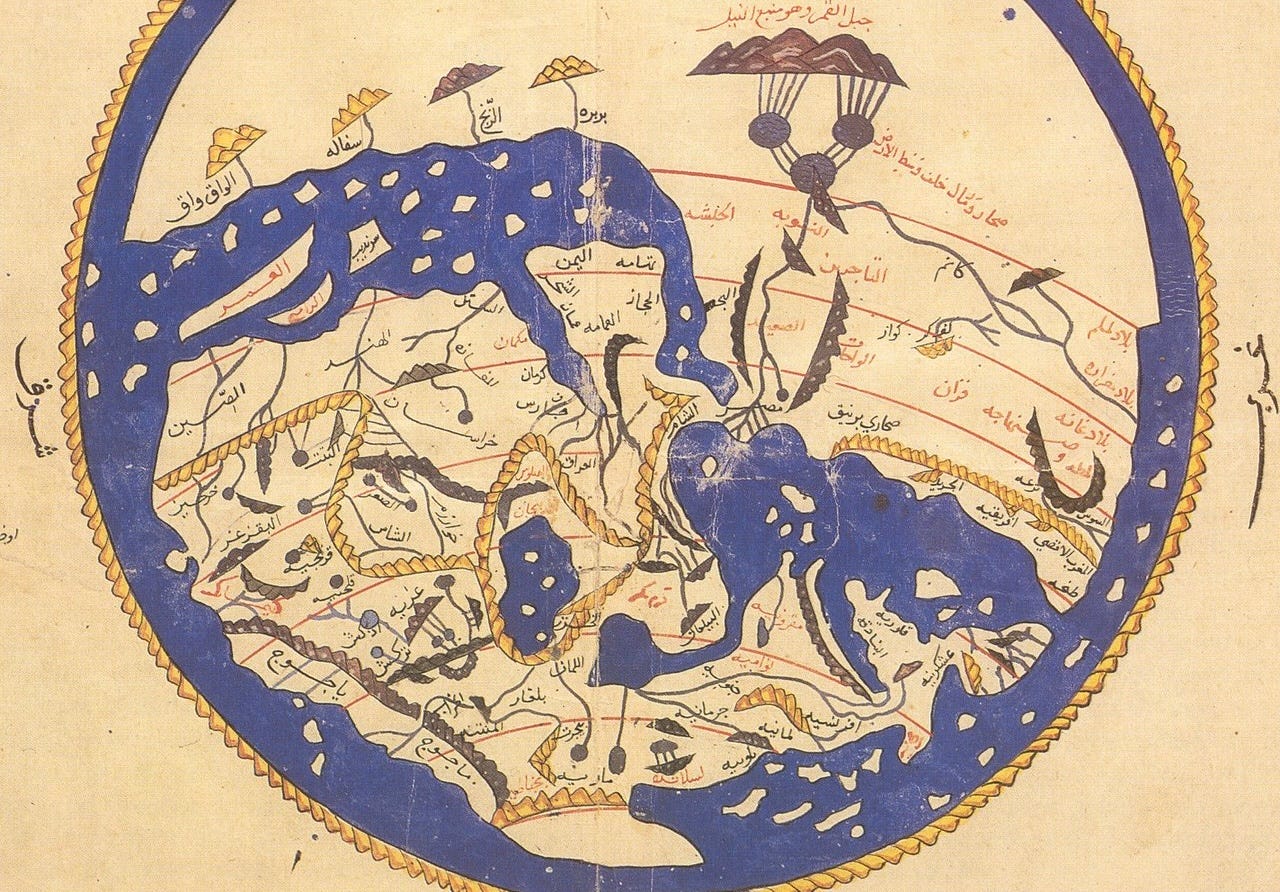
Al-Idrīsī’s 12th-century world map. Wikimedia Commons. Public domain.
Excerpt 1
The shape on my screen did not look much like a map, or indeed, like anything at all. It was unglamorous compared to the glossy displays you could generate using special software and pre-existing maps, stacking layers, running queries to get useful answers to important questions. But this skeletal thing was a map and I had made it from scratch.
Just months into my first job as a lowly geographic information systems programmer, I had assembled data from old survey records, put in the mathematical equations, and written the code. And now the map told me its story. I saw surveyors lugging heavy instruments, as I had for a paper in college once; I knew each data point had been earned under the hot sun. I saw moth-eaten files in dusty archives. I saw the lay of the land, how rainwater would run off, what could be grown, what could be built, what might become.
Excerpt 2
Horror vacui: Empty spaces on maps were so terrifying to ancient mapmakers that they filled them with decorations, fictional landscapes, and monsters. We moderns miss the beautiful monsters, but what if they never actually disappeared? What if the monsters were always part of the map, part of mapping itself?
In 1832, Radhanath Sikdar, a gifted mathematician, began his job as a sub-assistant in the Great Trigonometrical Survey of India. A monumental project undertaken by the British East India Company, it aimed to map the vast subcontinent with scientific precision—all the better for complete control. Indian “pundits” were employed to travel the land, traverse every kind of terrain, and take accurate measurements regardless of weather and work conditions. Later designated “chief computer,” Sikdar was—the Survey’s former superintendent George Everest suggested—“the cheapest instrument that Government ever could employ in a task of this kind.” He was also the first to figure out that a certain peak called “XV” was “higher than any other hitherto measured in the world.” The Royal Geographic Society promptly christened it Mount Everest, never mind the beautiful traditional names it already had in Tibetan and Nepali.
Kingdom of Funga: A Mycelial Reading List on a Strange and Surreal World Around Us
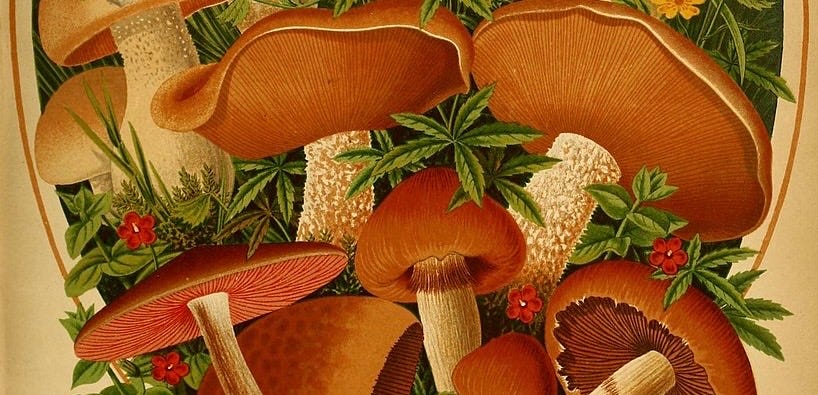
True and False Mushrooms, The Gardeners’ Chronicle. Wikimedia Commons. Public domain.
_(14781357891).jpg)
Excerpt 1
“Holy mother of god, what?!”
“Yeah, it’s true, the fungus burrows into the moth larva when it’s underground, then when the time is right, it bursts out of its head. I could show you.”
Our group is back from the trek and tending to the ponies we had left behind at lower altitude. We had gone way up the mountain. One of the Tibetan guides, the handsome one, is fiddling with the saddles and grinning as he imparts this arcane knowledge to me.
“And you eat this miscegenation? Why?!”
“Well, it gives you . . . powers.”
Excerpt 2
What do we know about these mysterious entities called fungi? This essay—a long walk through London’s Epping Forest that Macfarlane undertakes with mycologist Merlin Sheldrake (“truly, that is his name”), talking about what lies beneath our feet, beneath the forest floor—is a very good place to start. Opening with Suzanne Simard’s work on tree-fungus mutualism, the essay moves, with Sheldrake, into the “understory’s understory,” entangling life and language.
But is the beautiful “wood-wide web” theory wrong, after all? The formerly charmed scientific community seems to be arguing about it now, doesn’t it? Did Richard Powers’ Pulitzer-winning, Booker-shortlisted The Overstory (partly based on Simard) oversell things? Time will tell, and research. But for now, as Robin Wall Kimmerer says, “All flourishing is mutual.”
What’s Your Type? A Reading List on Typefaces with Wild Tales to Tell
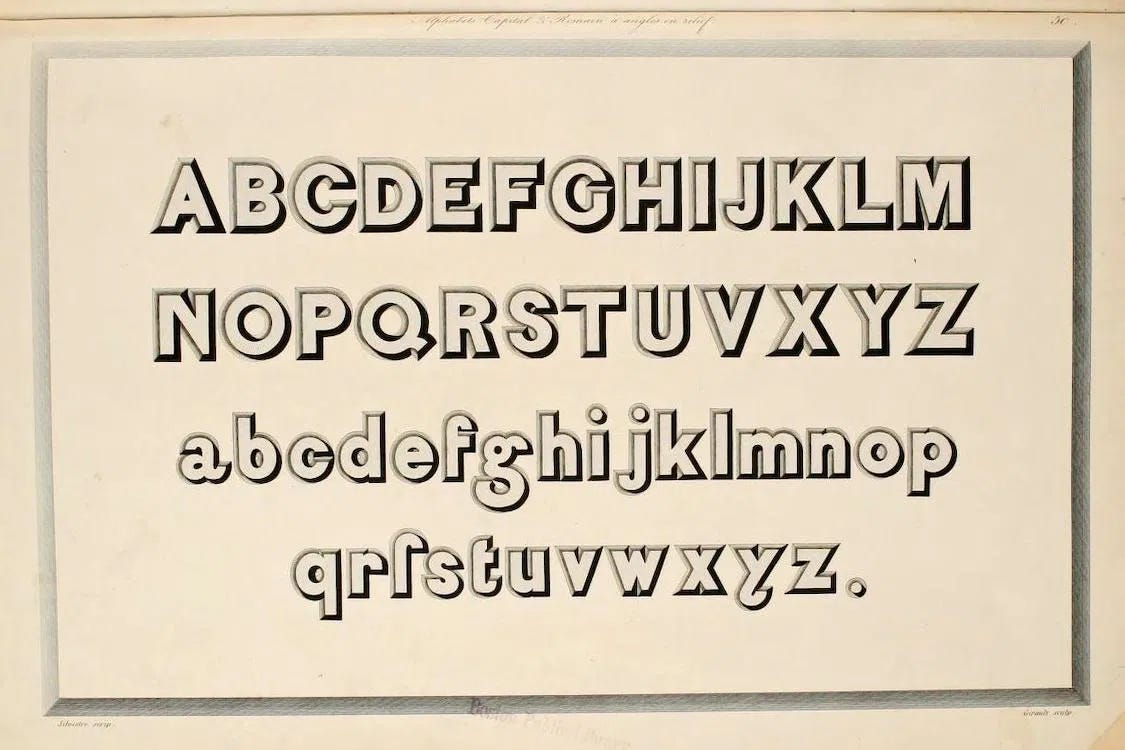
Joseph-Balthazar Sylvestre’s Alphabet Album. Internet Archive. Public domain.
Excerpt 1
A dimly lit cave wall; a piece of bark; a stone tablet; a blank sheet of paper; an empty page on a screen. A hand that makes a mark. A mind that exults in the mark it has just made.
Whatever great thoughts may swirl about in the mind, when it comes down to it, the artist must let out the artisan. The spoken word is a mark made in the air, the written word a mark made on a thing. Writers are mark-makers. And sometimes we want more than air.
Excerpt 2
Once upon a time, there was a software program called Microsoft Bob. In it was a yellow cartoon dog called Rover who spoke in comic-book speech bubbles. That’s how Comic Sans was born, says its creator Vincent Connare, because “dogs don’t talk in Times New Roman!” But then it spread throughout the world, infiltrating homes and schools and offices and the unlikeliest of places—harassment notices, suicide helplines, funeral homes, Pope Benedict XVI’s photo album. Its notoriety hit fever pitch when CERN, home of the largest and the most powerful particle accelerator, discovered the Higgs boson (“God particle”)—and chose to make the announcement in Comic Sans.
Knotty Business: A Delightfully Tangled Reading List on Knots
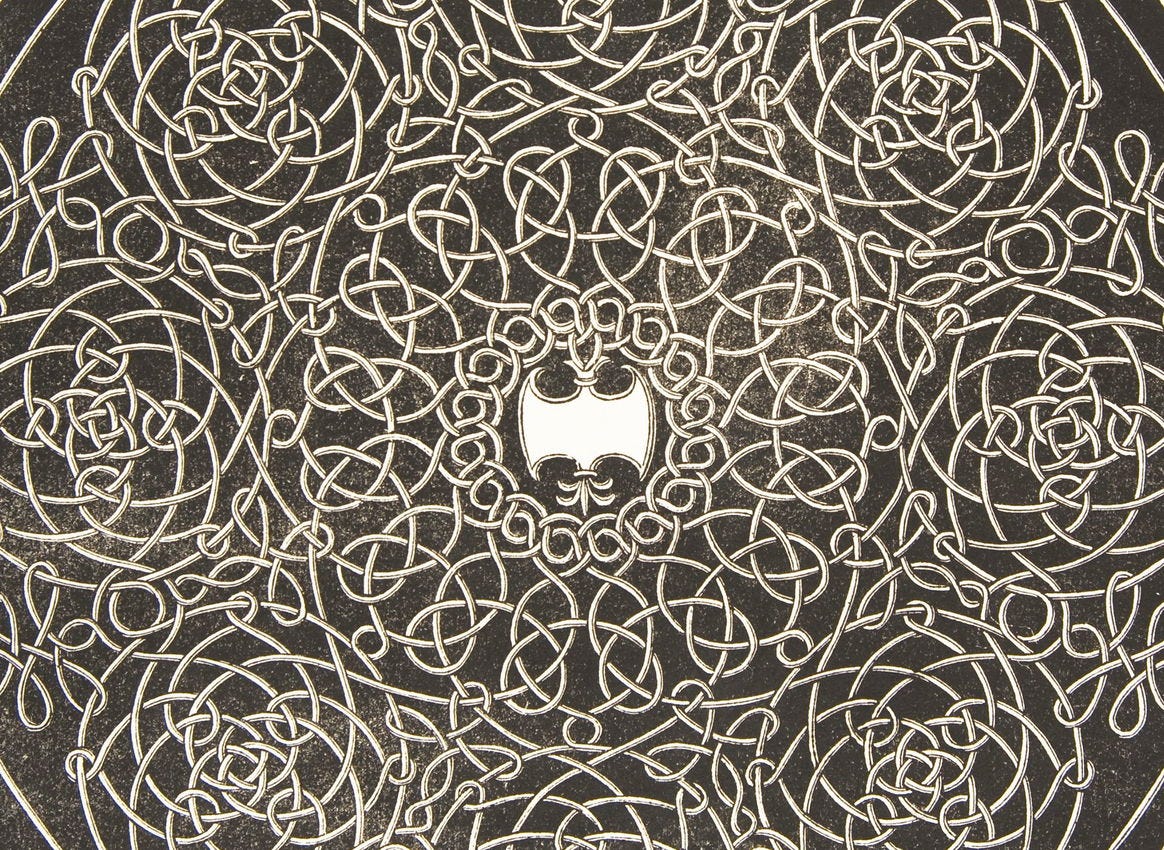
Dürer’s First Knot. The Metropolitan Museum. Public domain.
Excerpt 1
Scribes and surgeons, thieves and theologians, philosophers and pallbearers. Here’s what they all have—patron saints. Knotmakers have no saints. There is, however, Our Lady Undoer of Knots—Mary, serenely unkinking a long ribbon while stomping on a knotted serpent. Here’s St. Irenaeus of Lyons, a second-century Christian theologian: “The knot of disobedience of the first woman, Eve, was undone by the obedience of Mary; the knot the virgin Eve had created was undone by the Virgin Mary through her faith.”

Excerpt 2
I’ve been skimming The Ashley Book of Knots, a charmingly eccentric 1944 volume by sailor and artist Clifford W. Ashley. “I hobnobbed with butchers and steeple jacks, cobblers and truck drivers, electric linesmen, Boy Scouts, and with elderly ladies who knit.” A massive “adventure in unlimited space” with 7,000 illustrations, it is spoken of with near-religious fervor by knotmakers. “In Boston I halted an operation to see how the surgeon made fast his stitches. I have watched oxen slung for the shoeing, I have helped throw pack lashings, I have followed tree surgeons through their acrobatics and examined poachers’ traps and snares. But I never saw Houdini,” Ashley goes on to confess.
This public domain copy has no cover, and so I’ve downloaded the original cover image by George Giguere. Against an opalescent sky and an algal sea, an old, weathered sailor sits on a cask with a (mandatory) pipe clenched in his (mandatory) square jaw. He’s showing us the Tom Fool knot, also known as the conjuror’s knot. Now that’s an old knot. Heraklas, the Greek physician, called this knot epankylotos brokhos—the interlooped noose—in his list of surgical nooses and knots in the first century AD. Our sailor looks pleased he knows his history.

In Living Color: A Prismatic Reading List on Pigment, Paint, and Perception

If you go to a traditional chai shop in Kerala, chances are you’ll first get a glass of lovely pink hot water. The ruby comes from thirst-quenching patimukham, or pataṅga—sappan heartwood, Biancaea (earlier Caesalpinia) sappan. Other pink-red waters include khadira, Acacia catechu and padmaka, Prunus cerasoides. Photo © Kanya Kanchana
Excerpt 1
March 1832. Aboard the HMS Beagle in fair weather, Charles Darwin consulted a small guidebook from his pocket. “I had been struck by the beautiful colour of the sea when seen through the chinks of a straw hat,” he wrote in his zoological notebook. “Indigo with a little Azure blue,” he noted the color of the sea, and “Berlin with little Ultra marine,” the color of the sky, “with some cirro cumili scattered about.” A blue day.
Excerpt 2
At my writing desk, I run my finger along the tiny glass vials into which I have decanted a dozen oils and potions—root and bark, leaf and flower, fruit and seed—just so I can look at them in the light. I shall make beetroot for lunch, I think, and wash drawing paper in the purple juice. Or perhaps tip a generous green palette into white—bruise spinach with green chilies and curry leaves in coconut oil; crush raw mango with coconut for a chutney; dust some basmati in powder of moringa. “To work magic, to put enchantments upon others, one has first to put enchantments on oneself,” writes Indologist and art historian Heinrich Zimmer. I must color myself so I can soak you in some.
Untold Fortunes: A Reading List on the Creative Uses of the Tarot
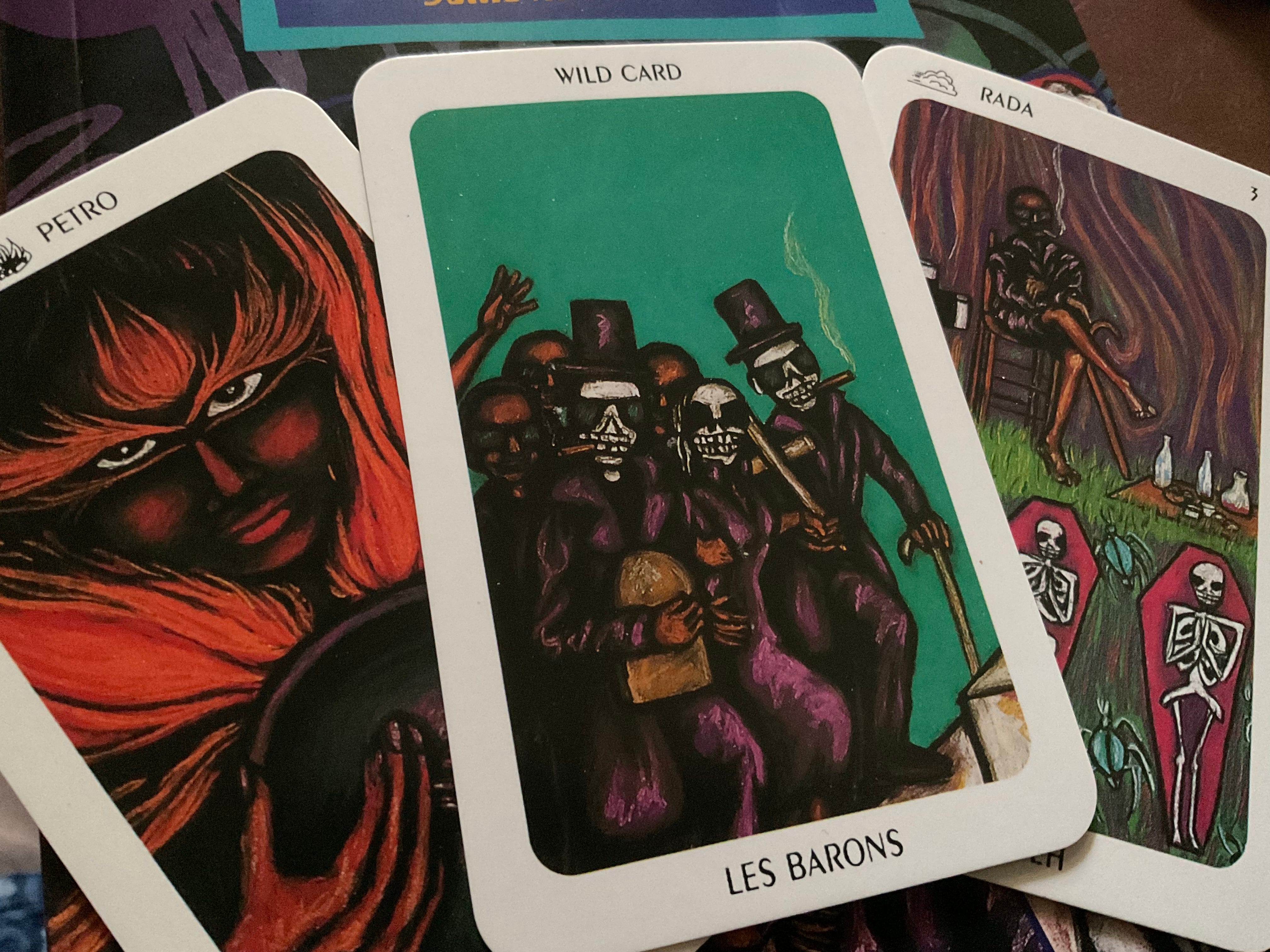
The Les Barons card from my New Orleans deck. Photo © Kanya Kanchana
Excerpt 1
“You must not talk about the future. The future is a con. The tarot is a language that talks about the present. If you use it to see the future, you become a conman,” says Alejandro Jodorowsky, maker of cult films El Topo, The Holy Mountain, Santa Sangre, and the unmade psychedelic Dune; writer of the legendary graphic novel series The Incal; and practitioner of the tarot.
When the story opens in the dystopian world of The Incal, our hero John Difool, holder of a Class R private detective’s license, has been beaten up by a masked gang in Suicide Alley and is falling headlong into an acid lake. Difool and Deepo, his pet concrete seagull, are versions of The Fool and his dog from the tarot. Characters across the galaxy, several fashioned after other cards, converge around the Incal, an ancient artifact of untold power and beauty. The game “begins here, not with a bang, but a whimper.”
Excerpt 2
I hold the old New Orleans deck in my hands. It has a perfectly satisfying aspect ratio. The syncretic vodun artwork is stunning. All decks have 78 cards, 22 of which comprise the Major Arcana. This deck has one extra, a wild card called Les Barons. Top-hatted, dark-glassed, cigar-smoking Baron Samedi and Baron Cimetière walk up some stairs with Manman Brigitte (to the French Quarter Police Station, I’m told). All grinning skeletons wearing long coats and carrying the respective accoutrements of their works—a curved walking stick, a headstone, a cross—they make me smile. Eros and Thanatos, awful without a few laughs. I shuffle the cards, a rustling hush. I hear the Sanskrit root śam that says pacifying, extinguishing; the root śi that says sharpening, focusing. If it’s all a game anyway, wouldn’t you like a deck of cards?
One Thing After Another: A Reading List for Lovers & Makers of Lists
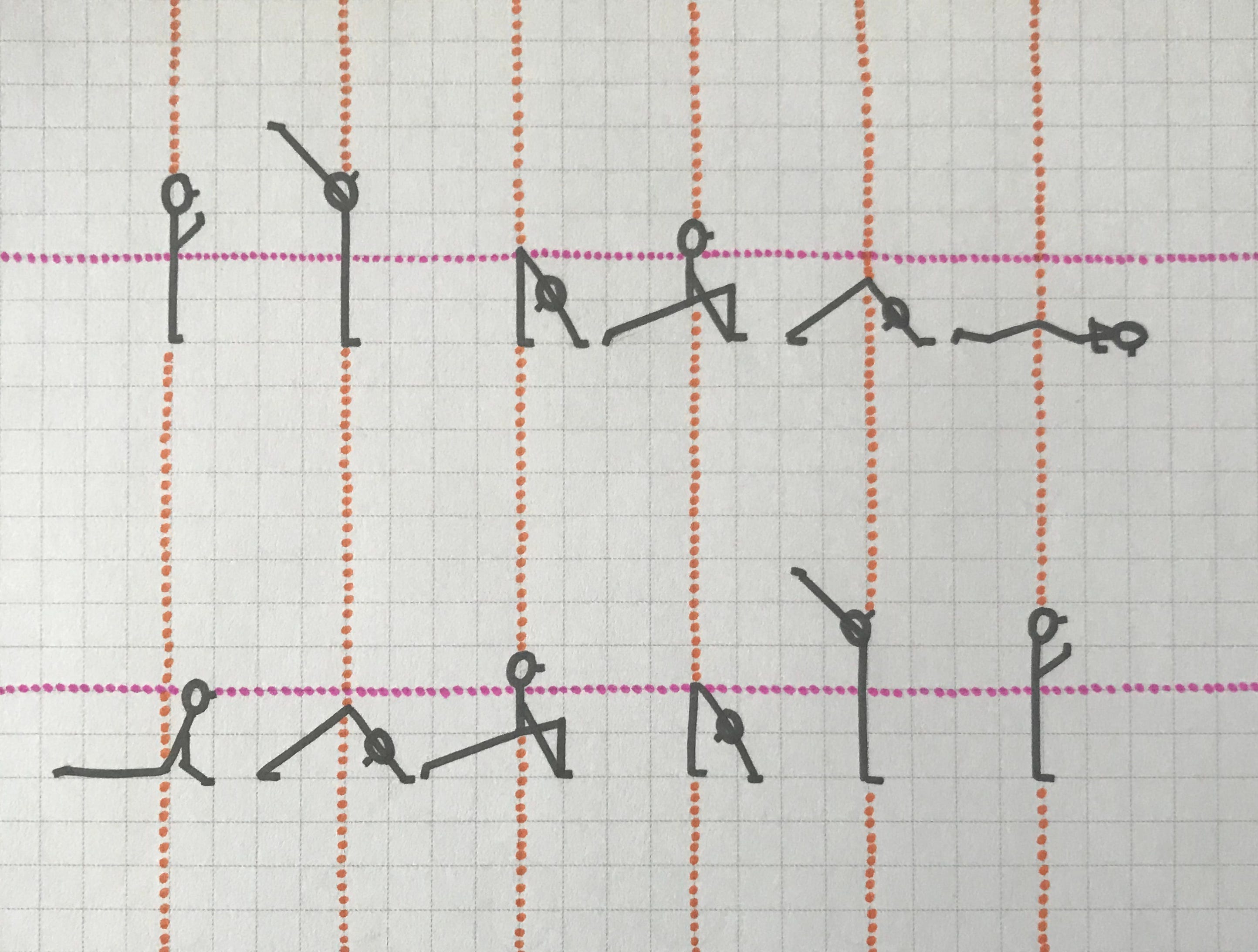
A visual list of the Sūryanamaskāra (Sun Salutations) yoga sequence I once made for my students. Illustration © Kanya Kanchana
Excerpt 1
As freshly minted adults in Bangalore with a bit of cash to spare, we bought books. We rooted among the used piles at Blossom Book House by day, haunted Petromax-lit roadside tarp shops by night, and scoured the infant internet for information by dial-up. I came upon a 1942 essay by Borges. He said, of a certain Chinese encyclopedia entitled Celestial Empire of Benevolent Knowledge: “In its remote pages it is written that the animals are divided into: (a) belonging to the emperor, (b) embalmed, (c) tame, (d) suckling pigs, (e) sirens, (f) fabulous, (g) stray dogs, (h) included in the present classification, (i) frenzied, (j) innumerable, (k) drawn with a very fine camelhair brush, (l) et cetera, (m) having just broken the water pitcher, (n) that from a long way off look like flies.”
A difficult and delightful outsider finally vindicated my love for lists. I was smitten.
Excerpt 2
We are not new to lists in the East. We are quite big on them, in fact. Take a look at how the Bhagavad-Gītā, the most intense part of the great Indian epic Mahābhārata, opens (summarised translation my own).
The battlefield of Kurukṣetra. It is the war to end all wars. The Pāṇḍava and the Kaurava armies are arrayed for battle, warrior after legendary warrior, each named, each terribly prepared. Sañjaya, a minister temporarily granted clairvoyance, has been tasked with giving Dhṛtarāṣṭra, the blind Kaurava king, a blow-by-blow narration. On the Kaurava side, the grand patriarch Bhīṣma blows his tremendous conch, roaring like a lion, setting off horns and trumpets, cymbals and drums, heralding what is to come. On the Pāṇḍava side, Kṛṣṇa blows his conch Pāñcajanya, and the five brothers theirs, Arjuna, his Devadatta, Yudhiṣṭhira, his Anantavijaya, Bhīma, his mighty Pauṇḍra, and Nakula and Sahadeva, their Sughoṣa and Maṇipuṣpaka. Thundering across earth and sky, the great sound shatters the hearts of the hundred sons of Dhṛtarāṣṭra.
A list. And the epic, which has all of life and then some, is strewn with lists.
Cover Image
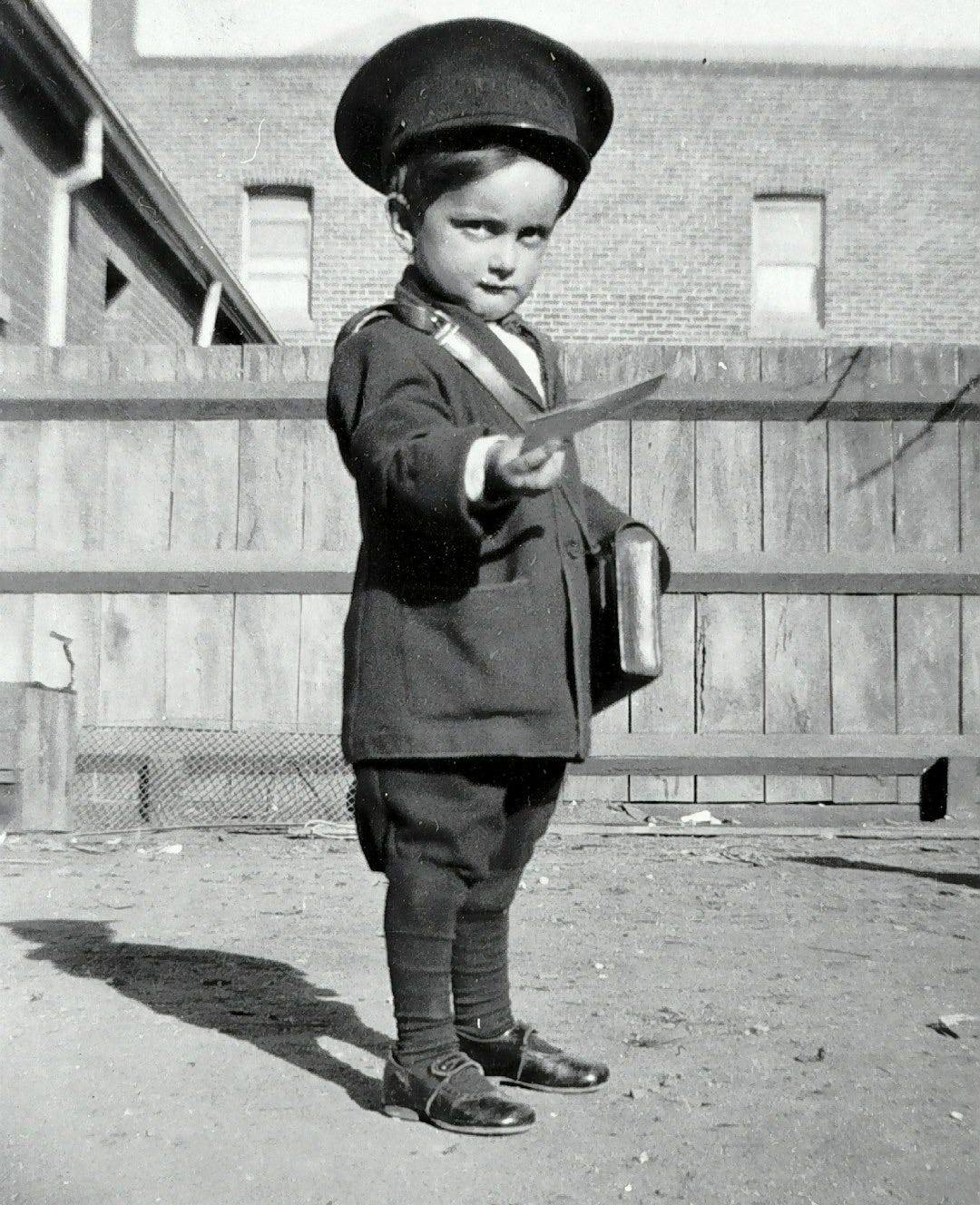
This historical image shows a little boy in some kind of miniature postal uniform. He wears a dark coat with large patch pockets, dark trousers tucked into dark socks, dark shoes, a peaked dark cap over his neatly combed hair, a leather satchel, and a solemn expression. He stands in front of a wooden fence, holding out what looks like a letter.
I did some digging. The photograph, likely a novelty picture from a family archive, is from Swan Hill, Victoria, Australia, 1921. The brick building in the background is the White Swan Hotel. If you look closely, you can make out the letter P on the child’s cap. The letters could be PMG, standing for the Office of the Post Master General, a Commonwealth establishment just 20yo at the time of the photograph.
Keywords
#longreads #longform #essay #readinglist